LATEST
In 1959, the Luna 2 probe from the Soviet Union became the very first human-made object to reach our closest celestial neighbor.
In the decades since, we have been leaving footprints - both literally and figuratively - all over the Moon.
Today, there are over 100 metric tons of human-made material resting on the Moon’s surface - everything from advanced cameras and sensors to literal human waste.
But that’s nothing compared to what’s to come.
NASA predicts the next decade will see over 100 new lunar missions, equaling or exceeding all the missions previously flown.
Which brings up a pressing question about all the stuff that’s already there - how do we protect that history? A new paper by Teasel Muir-Harmony, the Curator of the Space History Department of the Smithsonian and Todd Mosher, a Scholar in Residence at University of Colorado, Boulder, reports on a Smithsonian National Air and Space Museum and the American Institute of Aeronautics and Astronautics Summit on Outer Space Heritage that dives into the legal, scientific, and engineering hurdles of preserving these historic sites. On Earth, protecting historical buildings is a relatively straightforward process - at least in developed countries.
There are zoning laws and heritage registries - things that maintain the history but frustrate new developers.
In space, things are much more complicated.
The 1967 Outer Space Treaty dictates that nations retain jurisdiction over the hardware they send into space.
It also requires countries to avoid “harmful interference” with other states’ activities.
However, as the paper points out, that doesn’t stop a country from visiting an old site to retrieve material, or disrupt a culturally significant lunar landscape. More recently, the Artemis Accords introduced principles specifically intended to preserve historically significant landing sites and artifacts.
But the Accords are a non-binding multilateral agreement with no enforcement mechanism.
And crucially, major spacefaring nations like China and Russia haven’t signed them, meaning they have no legal obligation to abide by them.
In other words, the Accords, which were originally drawn up by America, which arguably has the most heritage to lose on the Moon, suffer from a distinct lack of global consensus. Video series of the Summit on Outer Space Heritage.
Credit - AIAA YouTube Channel Even the United States itself has sometimes treated its old lunar landing sites as potential technological opportunities rather than museum exhibits.
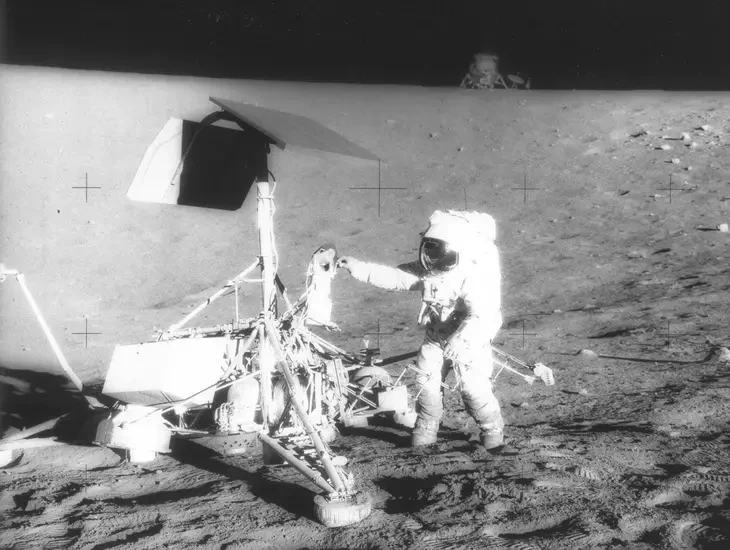
During the Apollo 12 mission in 1969, and back before there was really an understanding of what “lunar heritage” might mean, astronauts landed 600 feet from the robotic Surveyor 3 lander.
They walked over, snipped off the lander’s TV camera and a few other components, and brought them back to Earth.
To them, this had the great benefit of returning to a previous landing site for further study.