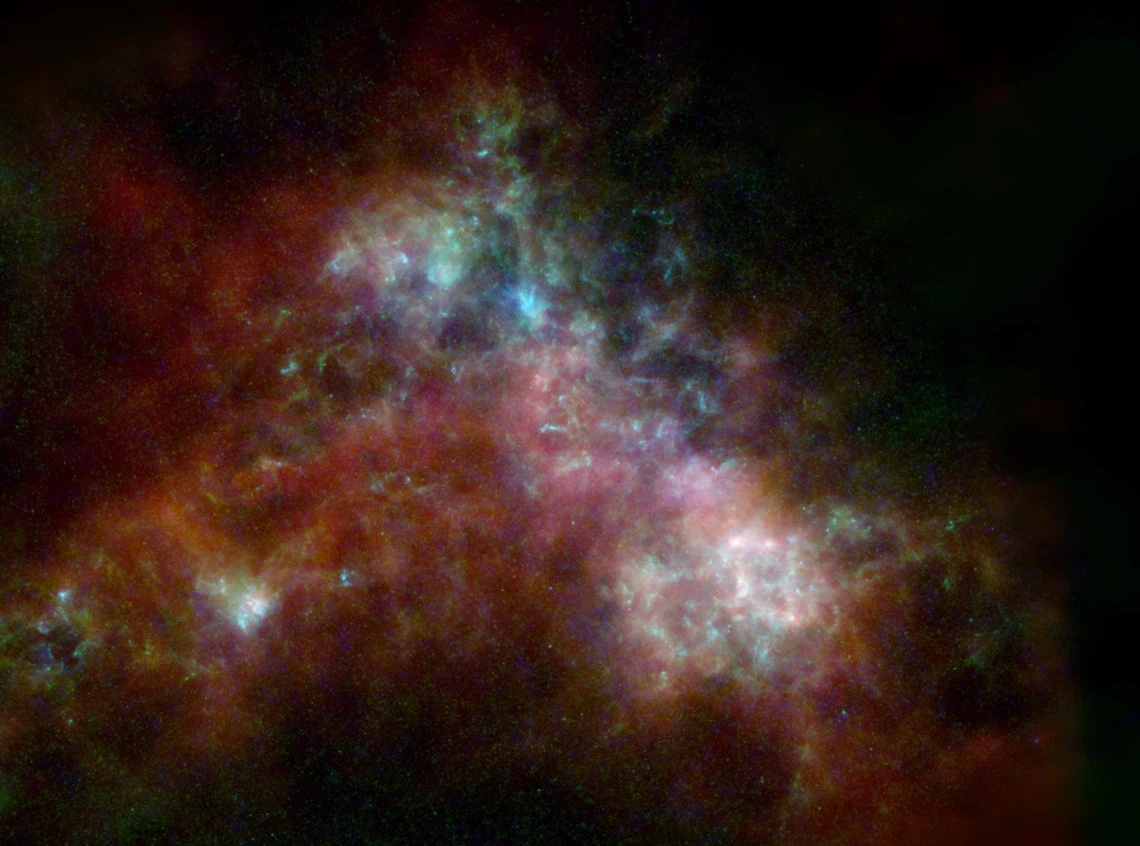
EDITOR'S PICK
A strange lack of stellar orbits around the core of the Small Magellanic Cloud (SMC) mystified astronomers for decades.
Not only that, but the SMC has a strange, irregular shape, and sports a tidal.
Now, a team of observers led by graduate student Himansch Rathore at the University of Arizona, has tracked down the reason why the stars don't orbit.
It's because the SMC crashed directly through its neighbor, the Large Magellanic Cloud (LMC), in the distant past.
That huge collision disrupted stellar motions andsent them on wildly different trajectories.
It also disturbed the clouds of gas within the SMC and created a tail of gas stretching out across space. The team's work provides unique insights into how galaxies change over time.
"We are seeing a galaxy transforming in live action," said Rathore.
"The SMC gives us a unique, front-row view of something very transformative of a process that is critical to how galaxies evolve." A Closer Look at the SMC The Small Magellanic Cloud is one member of a trio of interacting galaxies that includes our own Milky Way, in addition to the Large Magellanic Cloud.
The SMC lies about 200,000 light-years away, while the LMC is about 158,000 light-years distant.
Both have sites of active star formation.
The SMC is categorized as a dwarf irregular galaxy and has a mass equivalent to about 7 billion solar masses.
Not all that mass is in stars, however.
Most of the SMC's mass is in giant gas clouds that eventually become sites of starbirth.
That happens as the clouds cool and contract.
If conditions are right, the process creates hot, young stars that astronomers can study as they seek to understand the process of star formation. This visible light mosaic shows the LMC and SMC in context with the plane of our own galaxy, the Milky Way.
Dusty filaments create dark traces across the bright central plane of the Milky Way, visible across the top of the image.
Below it, separated by about 21 degrees, lie the LMC and SMC, the closest major galaxies to our own.
The LMC and SMC orbit each other as well as our own Milky Way galaxy.