MOST READ
Earth was once amagma oceanworld, just as all rocky worlds were early in their development, according to theory.
As the very young Earth cooled, only the outer core remained molten, wrapped around a solid inner core and covered by the solid mantle and crust.
This arrangement, along with coriolis forces, is what sustains our protective magnetosphere. Sulphur plays an important role in this.
It's a siderophile element, meaning it loves iron.
As iron sank to the core of magma ocean Earth, it dragged an enormous amount of sulphur with it.
Scientists think that up to 2% of the core is sulphur, which is a huge amount.
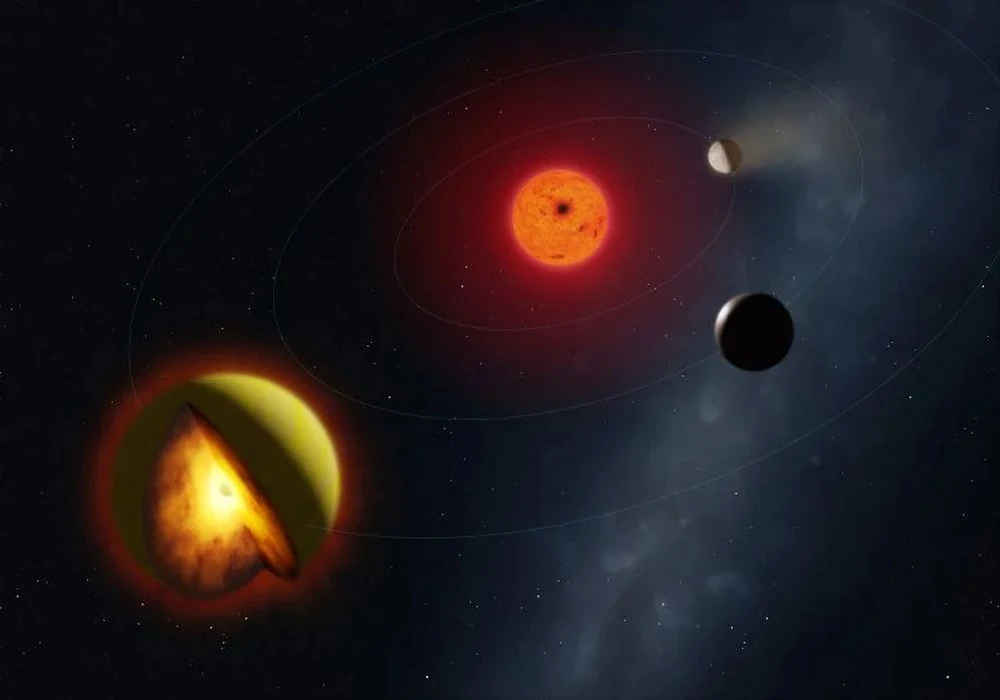
Since all of this sulphur lowers the melting point of the molten outer core, sulphur plays an important role in habitability. This relationship between sulphur and magma may be behind an entirely new class of exoplanet. New research in Nature Astronomy shows that the exoplanet L 98-59 d, discovered by TESS in 2019, is representative of a new class of exoplanets.
These planets remain as magma oceans far longer than planets like Earth, and its because of their sulphur content. The research is titled "Volatile-rich evolution of molten super-Earth L 98-59 d," and the lead author is Harrison Nicholls.
Nicholls is from the Department of Physics at Oxford University. L 98-59 d orbits an M-dwarf star about 35 light-years away.
When astronomers used the JWST and other telescopes to study the exoplanet, they found that it has an extremely low density.
It has 1.64 Earth masses and 1.627 Earth radii, giving it an approximate density of 2.2 g cm−3.
That's only about 40% of Earth's density, indicating that there's something very different about this exoplanet. Exoplanets with low densities and small sizes like this one are often slotted into one of two categories.
They can have rocky interiors with Hydrogen/Helium atmospheres, sometimes called gas dwarfs.
Or they can have bulk densities dominated by different phases of water, sometimes called water worlds. But L 98-59 d doesn't fit comfortably into either definition.
The researchers refer to it as a low-density super-Earth, and they used observations and models to figure out how it formed and evolved. "Here we constrain the possible range of evolutionary histories linking the birth conditions of low-density super-Earth L 98-59 d to recent observations using a coupled atmosphere–interior evolutionary model," the researchers write. The researchers modelled 5 billion years of the planet's history to understand how it reached its current state.
Their work allowed them to look inside the planet as it changed over time. They found that the planet has a mantle made of molten silicate, which is similar to lava here on Earth.
But the real surprise was found under the mantle.
Their work showed that L 98-59 d has a vast magma ocean that extends for thousands of kilometers below the mantle.