EDITOR'S PICK
Greek mythology has given a name to a great many objects in our solar system.
But perhaps one of the least well understood are the Trojans, named after the people of Troy featured in The Iliad.
When astronomers refer to them, they are normally talking about a group of over 10,000 confirmed asteroids orbiting at the Lagrange points both in front of and behind Jupiter on its orbit around the Sun.
But, more generally, astronomers can now use the term to refer to any co-orbital setup - indeed almost every planet in our solar system has Trojans, though not as many as Jupiter.
Which also leads to the belief that “exotrojans” must exist around other stars.
Despite our best efforts with initiatives like the TROY project, so far we have yet to find one.
But a new paper published in The Astrophysical Journal by Jackson Taylor of West Virginia University and an abundance of co-authors took the hunt to one of the most extreme environments in the universe: pulsar binary systems. A rough understanding of orbital mechanics is key to understanding where Trojans come from.
Between any two bodies floating in space there is a gravitational tug of war where the gravities from each object pull on the other one.
When those two bodies are massive, like a star and a planet, this creates distinct pockets of gravitational equilibrium, typically formed by an equilateral triangle with the two main bodies, leading and trailing the smaller one by 60 degrees on its orbital path.
These are known as two of the Lagrange Points - specifically L4 and L5 - of the system.
If a third object, like an asteroid or even a smaller planet, wanders into one of these spots, it can become trapped and orbit in tandem with the larger planet indefinitely. Astronomers have been hunting for these objects around ordinary, main-sequence stars for a while now.
But Taylor’s team turned their attention to “black widow” pulsars instead.
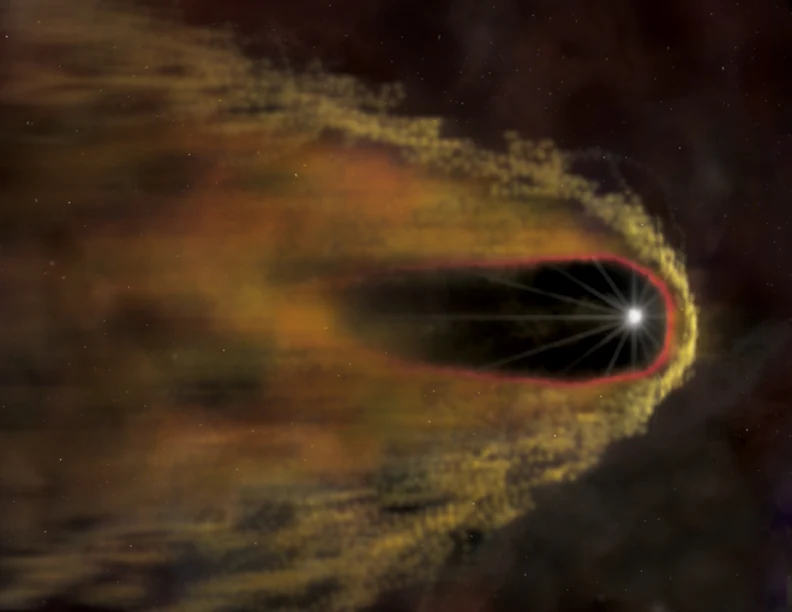
These violent binary systems are made up of a rapidly spinning millisecond pulsar and a much smaller companion star, which is often around 1% of the mass of the Sun.
The intense radiation from the pulsar slowly strips material away from its companion, effectively destroying it over time - hence the nickname “black widow”. NASA depiction of a black widow pulsar eating its companion.
Credit - NASA Goddard YouTube Channel This might seem like less than an ideal place to look for co-orbiting planets.
However, the low mass companion actually means that the math for finding stable orbits in this system is actually more likely than that around more ordinary binary star systems. Even so, it’s not like astronomers can directly see a Trojan exoplanet, especially not with a black widow pulsar flailing nearby.
Traditional methods of exoplanet detection fail in these systems.
Exoplanet detection usually watches for small gravitational pulls of a planet on its host star, but in these binary systems, that gravitational pull would be from the companion star, not from any Trojan planet, which would be even smaller. To make up for this difficulty, Taylor and his team tried two different detection techniques.