EDITOR'S PICK
The Milky Way could host billions of free-floating planets (FFP) according to some research estimates.
Also called rogue planets, these worlds drift through interstellar space on their own trajectories, unbound to any star.
Many of these worlds form around stars like other planets do, and so it's reasonable to think that they also have moons. Typically, rogue planets are ejected from their systems by planet-planet interactions or stellar flybys.
In some cases, planetary scientists think they could form via direct collapse like stars do and may have never orbited a star.
Regardless of how they form, if there are billions of them, it's almost certain that some of these planetary drifters have exomoons. Though spending billions of years drifting through the cold vacuum of space would seem to contraindicate life appearing and evolving on these moos, new research says that's not necessarily the case.
The FFPs themselves may be too cold, but their moons could be kept warm.
In fact, given the right conditions, complex life could even evolve on these exomoons, at least theoretically. New research in the Montly Notices of the Royal Astronomical Society explains how this could happen.
It's titled "Habitability of Tidally Heated H2-Dominated Exomoons around Free-Floating Planets," and the lead author is David Dahlbüdding, a doctoral researcher in physics Ludwig-Maximilians-University in Munich, Germany. Life needs liquid water, and liquid water needs a heat source.
So for exomoons to host life, a heat source is needed.
Without a star to provide it, the heat can come from two other sources.
Some of the moons in our Solar System show us how. Even though they're at great distances from the Sun, Jupiter's moons Europa and Ganymede both have subsurface oceans (we think.) Tidal flexing keeps Jupiter's moon Europa warm enough for its ice-covered ocean to remain liquid.
Radiogenic heating does the same for Ganymede.
The same mechanisms could help rogue planets and their exomoons remain warm. In this work the authors focus on exomoons orbiting planets that were once part of a solar system.
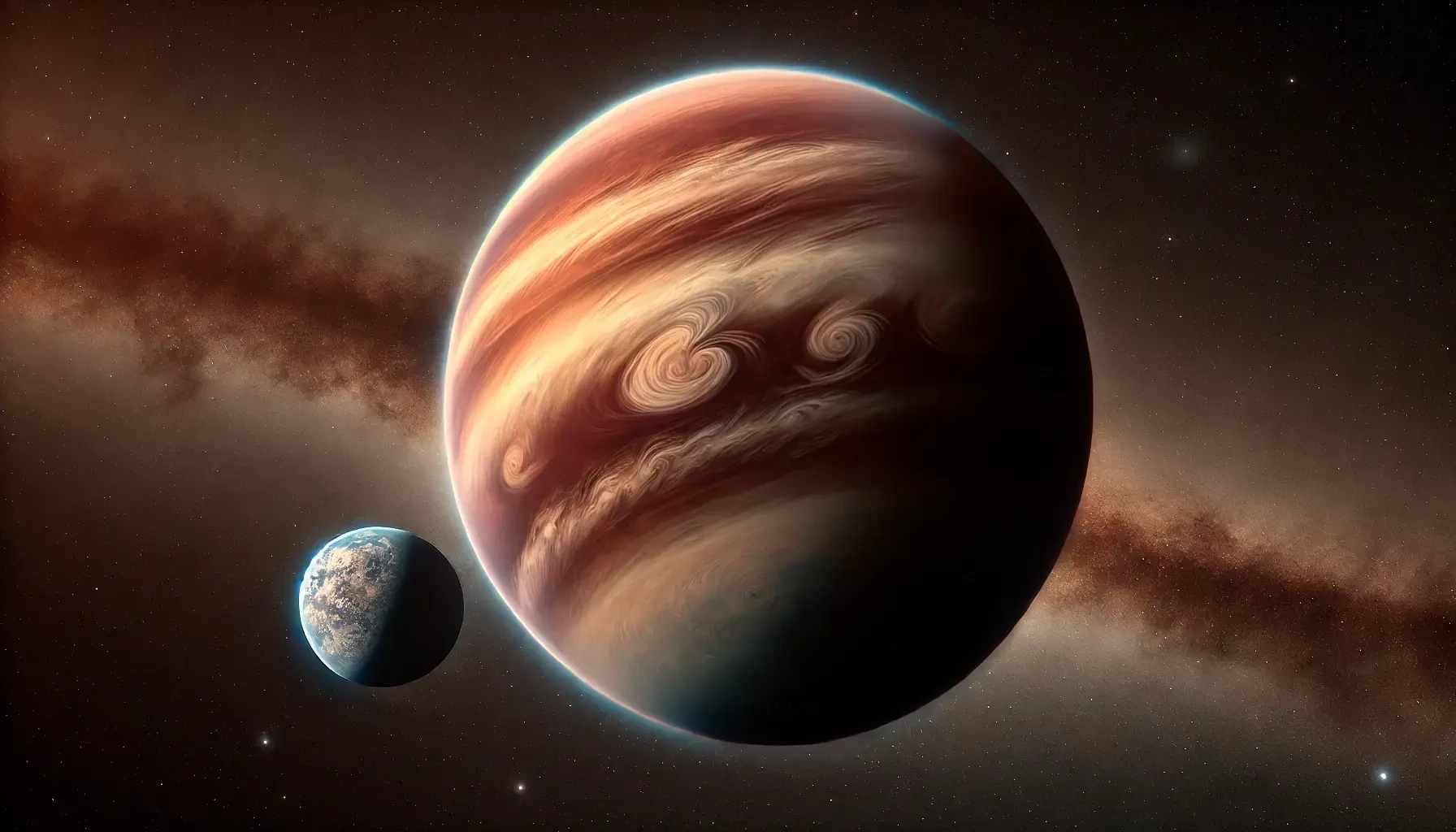
They modelled 26,293 Earth-mass exomoons orbiting Jupiter-mass FFPs.
Earth-size moons are important because less massive moons don't generate as much heat during tidal flexing.
Less massive moons also lack the gravity to hold onto thick enough atmospheres.
"Hence, an Earth-like exomoon presents a plausible best-case scenario," the authors write. When an FFP is ejected from its solar system, its moon likely ends up in and eccentric orbit around the FFP, unless it's thrown out of orbit completely.
That's key to this work. "Exomoons around free-floating planets (FFPs) can survive their host planet’s ejection," the authors write.