MOST READ
To understand how stars form, astronomers need to watch the process play out in galaxies.
That simple fact is behind PHANGS, the Physics at High Angular resolution in Nearby GalaxieS survey.
It's a large-scale, multiwavelength, multitelescope survey of dozens of nearby spiral galaxies.
Its targets are galaxies close enough that star-forming features like giant molecular clouds (GMCs), HII regions, and stellar clusters can be resolved. PHANGS started years ago with observations from telescopes like ALMA and the Hubble.
When the JWST was launched, it participated as well.
The core question that PHANGS is addressing is simple: How exactly does gas become stars, and how does stellar feedback modulate the process? PHANGS has generated catalogs of data that's been cited in more than 150 scientific papers.
It's been a huge success for astronomers who study stellar formation and feedback.
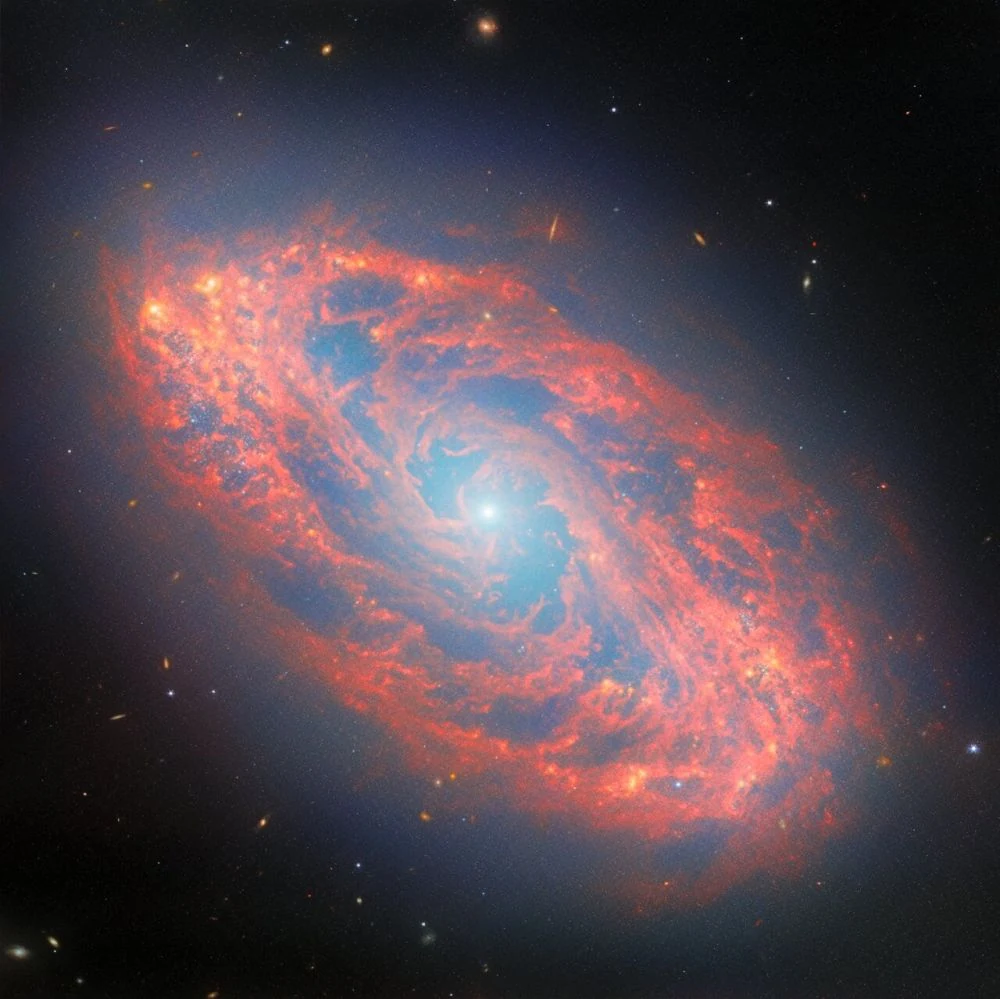
But it's also generated a collection of gorgeous images, many of which have been featured as a Picture of the Week (POTW), Astronomy Picture of the Day (APOD), as well as other featured images, and even anESA/Hubble calendar.
There's also apostage stampfeaturing the JWST's image of NGC 628. The JWST's image of the spiral galaxy NGC 628 is featured in a US Postal Service stamp.
Image Credit: NASA, ESA, Canadian Space Agency, and Space Telescope Science Institute.
US Postal Service. The JWST has made an important contribution to PHANGS.
It's kind of like the missing link in the survey, because it can see inside dust better than other telescopes.
That means it can see earlier stages of star formation than its comrades. But as Universe Today readers know, the telescope's portraits of spiral galaxies are delicious as stand alone images, even without the scientific context.
We were all excited by the galactic portraits the JWST gifted us in 2023.
They placed Nature's creative glory on a pedestal where it belongs. This mosaic shows 19 galaxies imaged in near- and mid-infrared light by the JWST as part of PHANGS.
There's so much beauty and detail it's hard to digest it all.
Image Credit: NASA, ESA, CSA, STScI, J.
Lee (STScI), T.