MOST READ
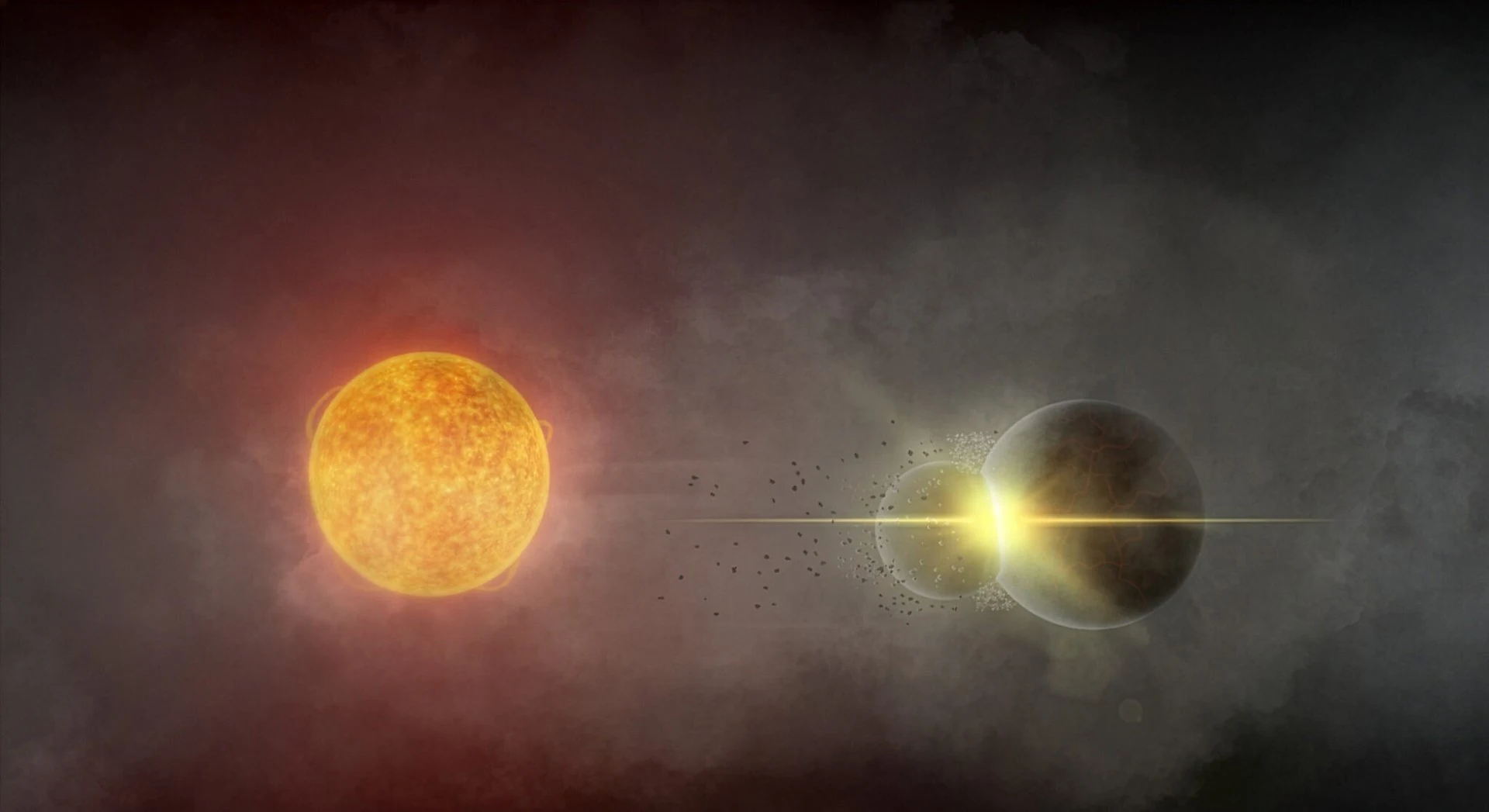
Astronomers say unusual readings from a star system 11,000 light-years away suggest that two of the planets circling the star crashed into each other, creating a huge, light-obscuring cloud of rocks and dust. The analysis, laid out this week in apaper published by The Astrophysical Journal Letters, could provide new insights into the occasionally cataclysmic process that governs the evolution of planetary objects — including our own planet Earth and its moon. “There are only a few other planetary collisions of any kind on record, and none that bear so many similarities to the impact that created the Earth and moon,” University of Washington graduate studentAnastasios Tzanidakis, the study’s lead author,said in a news release.
If we can observe more moments like this elsewhere in the galaxy, it will teach us lots about the formation of our world.” Tzanidakis found the first clues while combing through archival data from theGaiaspacecraft and other sky surveys.
He was particularly intrigued by Gaia20ehk, a sunlike star near the constellationPuppis. “The star’s light output was nice and flat, but starting in 2016 it had these three dips in brightness.
And then, right around 2021, it went completely bonkers,” Tzanidakis recalled.
“I can’t emphasize enough that stars like our sun don’t do that.
So when we saw this one, we were like ‘Hello, what’s going on here?’ ” The star called Gaia20ehk — seen in the center of the orange crosshairs in the inset image — is 11,000 light-years from Earth, near the constellation Puppis.
(Credit: NASA / NSF NOIRLab) Tzanidakis specializes in tracking extreme variability in a star’s brightness.
A couple of years ago, he played a role in the detection of a binary star system with a dust cloud thatcaused a seven-year eclipse.
But Gaia20ehk was a puzzler: Its pattern of short dips in brightness, followed by chaotic flickering, hadn’t been seen before. ThenJames Davenport, a UW assistant research professor of astronomy who works with Tzanidakis, had a suggestion: Why not look at readings from a different telescope that were captured in infrared rather than visible-light wavelengths? “The infrared light curve was the complete opposite of the visible light,” Tzanidakis said.
“As the visible light began to flicker and dim, the infrared light spiked.
Which could mean that the material blocking the star is hot — so hot that it’s glowing in the infrared.” That behavior would be consistent with a violent smash-up between two planets in the Gaia20ehk that left behind a hot cloud of debris.
Such a scenario could also explain the dips in brightness that came before the chaos. “That could be caused by the two planets spiraling closer and closer to each other,” Tzanidakis said.
“At first, they had a series of grazing impacts, which wouldn’t produce a lot of infrared energy.
Then, they had their big catastrophic collision, and the infrared really ramped up.” Astronomers suggest our own planet was involved in just such a crash4.5 billion years ago.
The most widely accepted hypothesis holds that aMars-sized protoplanet dubbed Theiasmashed into theproto-Earth, throwing off a huge glob of debris that coalesced to form the moon. Gaia2ehk’s debris cloud is thought to be orbiting its parent star at about one astronomical unit, which is equal to the distance between Earth and the sun.
At that distance, the material could eventually cool down enough to form something similar to our Earth-moon system. It’s hard to tell how long the cooling-down process could take for Gaia2ehk’s debris cloud, but astronomers say our own moon might have formed in a matter of months, days orperhaps even hours. Now Tzanidakis and Davenport, who’s the senior author of the paper published this week, are hoping to observe more planetary smash-ups.
They’re expecting a flood of data from the Vera C.
Rubin Observatory in Chile when it begins itsLegacy Survey of Space and Timelater this year.