TRENDING
In addition to being a staple of science fiction, the concept of megastructures has long been the subject of serious scientific studies.
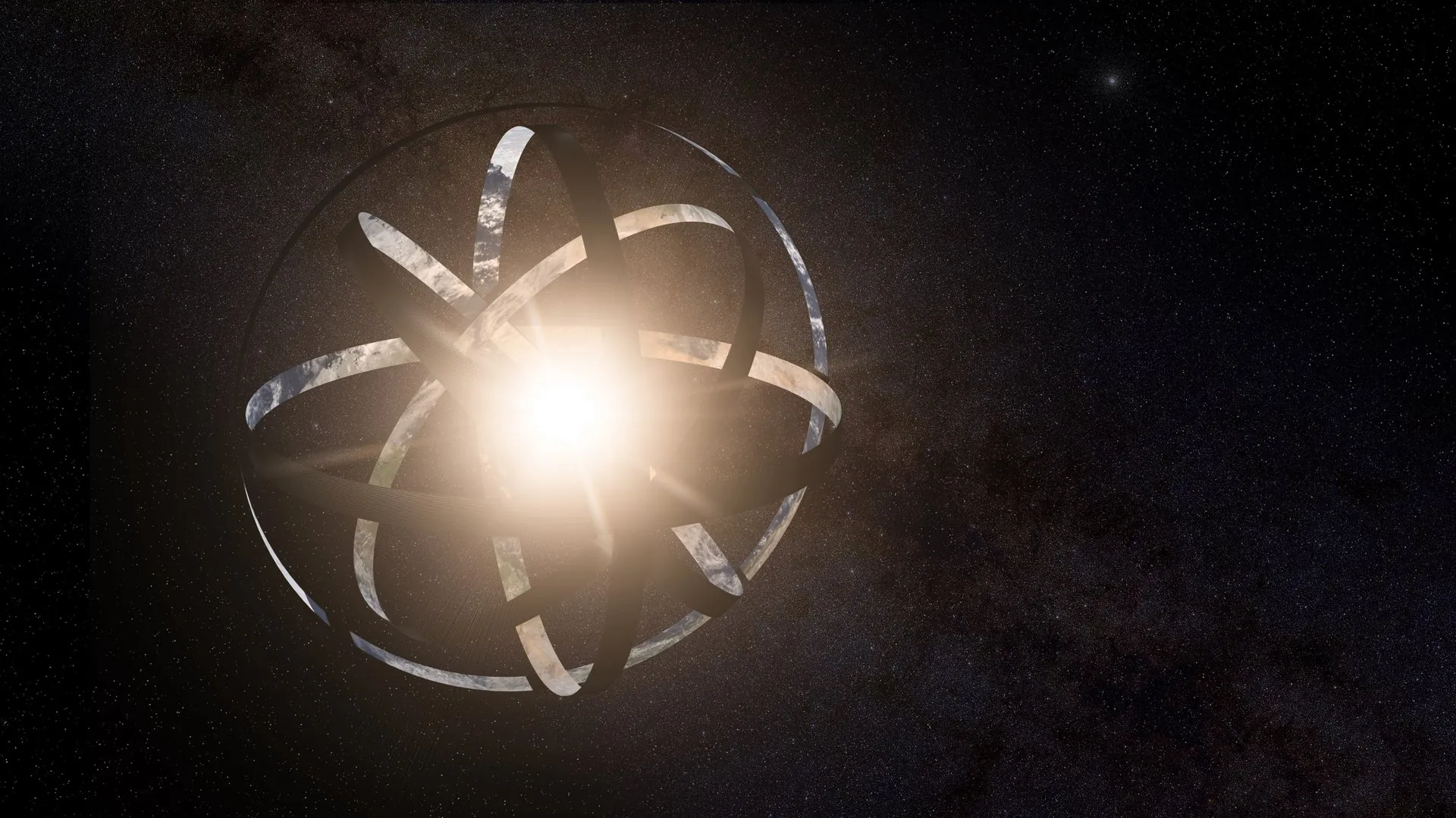
As famed physicistFreeman Dysonoriginally proposed in 1960, "Malthusian pressures will ultimately drive an intelligent species" to occupy an "artificial biosphere which completely surrounds its parent star." In short, he theorized that advanced civilizations would disassemble their planet (or planets) to create a structure (which has since come to be called a "Dyson Sphere" that would harness all the energy from their star and provide immense living space. Over time, scientists have proposed many variations on this structure, collectively known as "Dyson Structures." However, considerable research has countered these proposals, arguing that such megastructures would be unstable.
In a new study, famed engineerColin R.
McInnesdemonstrates how two specific megastructures -Dyson Bubbles and Stellar Engines- could be built in such a way that they would be passively stable over time.
These findings could aid the Search for Extraterrestrial Intelligence (SETI) by constraining the technosignatures these structures could produce. Colin R.
McInnes is a Professor of Engineering Science at the University of Glasgow and the chair of the James Watt School of Engineering.
His findings are presented in a paper that appeared in theMonthly Notices of the Royal Astronomical Society.While the concept is several decades old, megastructures have received renewed attention thanks to the discovery of Boyajian's Star and other cases where stars exhibited periodic dimming, were low in luminosity, or were "missing." In addition to being a leading figure in the field of solar sails, reflectors, and satellites, McInnes has also previously authored a paper on the subject ofmegastructure stability.
As he summarized in this latest study, megastructures have been proposed for a range of ventures, including asteroid orbit modification, climate engineering (i.e., solar shields), terraforming (a la Ken Roy'sShell Worldconcept), and planetary orbit modification (moving them into the star'shabitable zone). At larger scales, scientists have considered how massive swarms of reflectors could enshroud a star, known as a Dyson Swarm, Bubble, or Matrioshka Brain, or be used to alter a star's orbit, known as a Stellar Engine orShkadov Thruster.
In the case of the former, the reflective surface ensures that radiation pressure will levitate the swarm (which could support habitats) above the star.
In the latter, a flat reflective disk remains bound to a star through gravitational coupling, causing the star to move. Much like Dyson proposed in his original paper, these studies assume that advanced civilizations will experience exponential growth and rising energy demands as they age.
"Freeman Dyson imagined a swarm of energy-collecting elements enveloping a central star as an endpoint for a civilisation with continuously growing energy demands," McInnes told Universe Today via email.
"It’s clearly difficult to infer motivations.
However, the universality of the laws of physics means that we can at least speculate on how such structures could be engineered." While a popular idea among scientists, considerable research by physicists and structural engineers has cast doubt on the existence of megastructures.
In short, they have argued that such structures would be, by their very nature, gravitationally unstable.
But as McInnes explained, it is possible that megastructures could be built in a way that would ensure long-term passive stability: Many concepts, such as a rigid Dyson sphere or Ringworld, are not in orbit, and so a small displacement can cause the structure to drift and collide with the central star.
They would therefore need active control measures to stabilise them.
However, my interest is in understanding ways in which ultra-large structures could be engineered so that they are passively stable.
We can imagine that engineers, terrestrial or otherwise, would prefer passive stability to more complex active control measures. The simplest design (he notes) for a Stellar Engine would likely be a flat reflective disk.