MOST READ
There are some strange types of exoplanets out there with no counterparts in our Solar System.
One of those types is super-puff planets.
These oddballs have radii larger than Neptune, but only have a few Earth masses.
This means they have large volumes and low density.
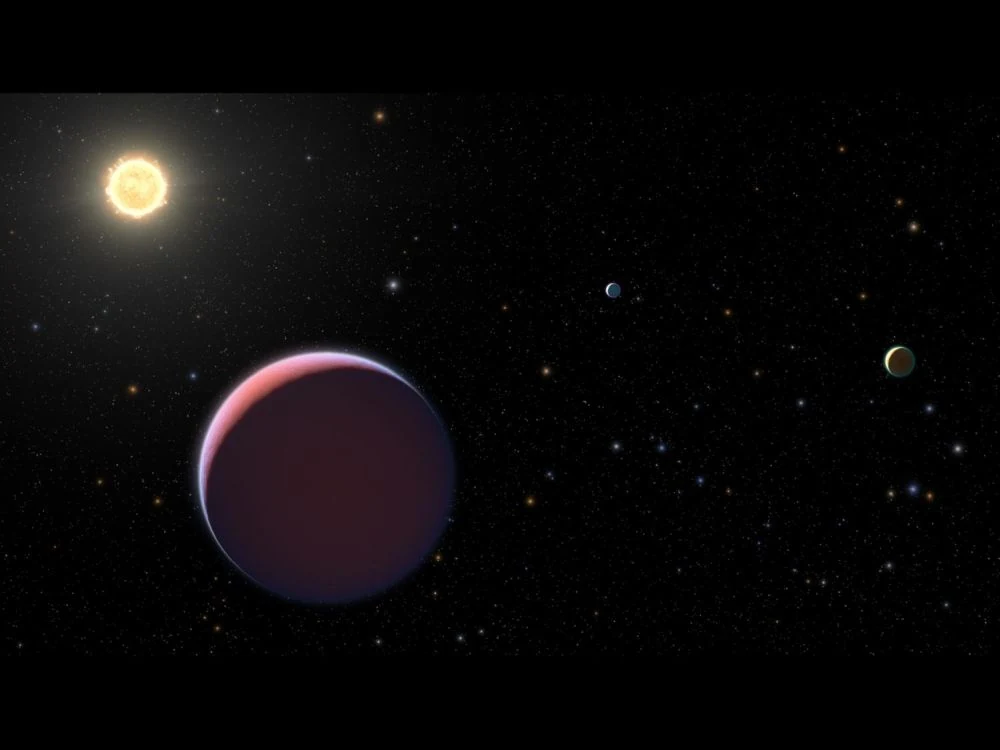
How this peculiar type of exoplanet forms is unclear, and current models of gas giant formation can't account for them. Kepler-51 is 500 million year old Sun like star about 2620 light-years away that hosts 3 super-puff planets.
One of them, Kepler-51d, is the coolest and the least dense of the three.
It's the subject of new research in The Astronomical Journal.
In it, the researchers test the three hypotheses that try to explain Kepler-51d, and super-puffs in general. The research is "The James Webb Space Telescope NIRSpec-PRISM Transmission Spectrum of the Super-puff, Kepler-51d," and the lead author is Jessica Libby-Roberts.
Libby-Roberts is from the Department of Astronomy & Astrophysics and the Center for Exoplanets and Habitable Worlds, both at Pennsylvania State University. “We think the three inner planets orbiting Kepler-51 have tiny cores and huge atmospheres giving them a density akin to cotton candy,” said lead author Libby-Roberts in apress release.
“These ultra-low-density super-puff planets are rare, and they defy conventional understanding of how gas giants form.
And if explaining how one formed wasn’t difficult enough, this system has three!” Retaining a large puffy atmosphere requires a massive core with enough gravity to prevent the atmosphere from being stripped away.
Typically, these types of planets are also further from their stars, which also makes it more difficult for the star to remove their atmospheres.
But Kepler-51d is only as far from its star as Venus is from the Sun.
And since Kepler-51 is young, only about 500 million years old, it's more active than older stars like the Sun. “Kepler-51 is a relatively active star, and its stellar winds should easily blow away the gasses from this planet, though the extent of this mass-loss over Kepler-51d’s lifetime remains unknown,” said Libby-Roberts.
“It’s possible that the planet formed further away and moved inward, but we are still left with a ton of questions about how this planet — and the other planets in this system — formed.
What is it about this system that created these three really oddball planets, a combination of extremes that we haven’t seen anywhere else?" Kepler-51d is one of the lowest-density examples of this type of exoplanet, along with being the coolest one in the system.
It's planetary mass is about 5.6 Earth masses, and its radius is about 9.3 Earth radii.
That means that it's nearly 10 times Earth's radius but just over 5 times Earth's mass.