LATEST
Traditional chemical rockets, though they are the most commonly used propulsion method for space exploration today, are beholden to the tyranny of the rocket equation.
Every ounce of thrust they use must also start out as fuel, which means the rocket itself will have to weigh more, and weight is one of the limiting factors in how fast a propulsion system can go.
So, scientists have been searching for, and actively testing, alternatives for decades.
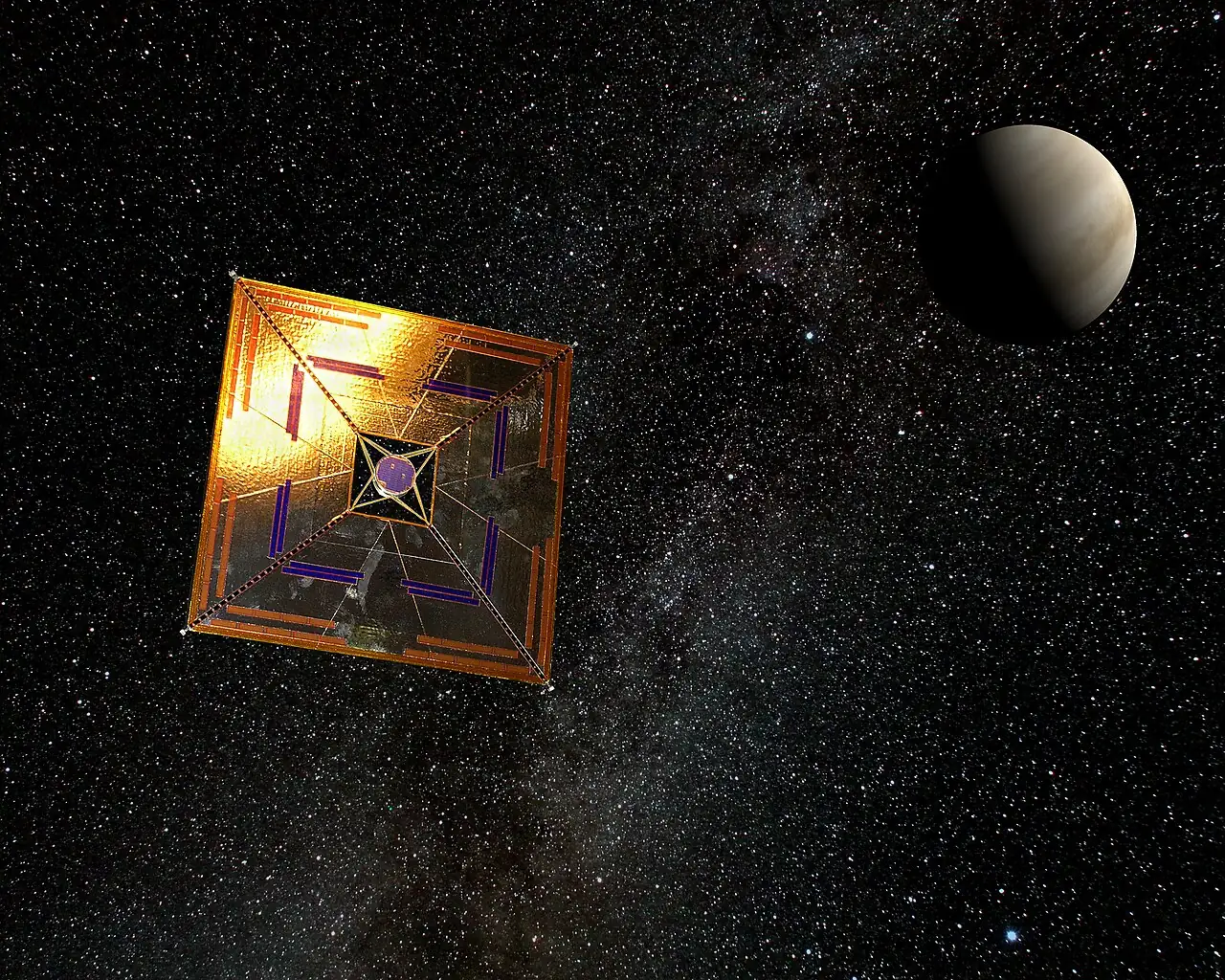
One of the most promising is the solar sail - a huge reflective sheet that uses sunlight, or in some cases a “pushing laser” to maneuver about the solar system without any onboard propellant necessary.
A recent paper published in the Journal of Nanophotonics by Dimitar Dimitrov and Elijah Taylor Harris of Tuskegee University describes a new type of light sail that solves some of the major problems of existing designs. As with so many other things in space exploration, the problem with light sails comes down to heat.
Typically they are made with flexible polymer films, like Mylar or Kapton, which are great for a size to weight ratio.
But, they absorb 47% of incident solar radiation, which must then be converted into heat.
With intense solar radiation close to the Sun, that level of heat can degrade or destroy the sail entirely.
More importantly, it’s infeasible to hit a sail with a giga-watt level pushing laser, and it would just be shredded immediately. Current solutions essentially amount to adding more material to allow for better thermal management.
But that falls into the same trap as the rocket equation - the sail must carry that mass with it during its journey, dramatically reducing the efficiency of its propulsion.
Simply using standard off-the-shelf material doesn’t get around that problem. Fraser talks about why solar sails are so great. So the researchers decided to come up with an even more novel material - what they’re calling a multi-dielectric Photonic Crystal Light Sail (PCLS).
This nanoscale structure has three repeating components - high refractive index germanium pillars, low refractive index air holes, and a poly(methyl methacrylate) (PMMA) polymer matrix.
By arranging these three components carefully at the nanoscale, the researchers are able to create a “photonic band gap” that acts as a highly selective mirror. The sail achieves 90% reflectivity at a very specific wavelength of light - a 1.177 micrometer wavelength to be precise.
But, because of the air gaps, which make up the majority of the structure, the vast majority of actual sunlight simply passes right through the material.
This eliminates much of the unnecessary heating traditional solar sails suffer from, and dramatically decreases the weight of the sail itself.
Since most of it is just air anyway, the authors estimate that one square meter of the material would only weigh 7.2 grams. To prove their concept, the team did the classic combination of material science - they modeled it to check its performance properties, and then built a sample.
Using mathematical techniques like plane-wave expansion and finite-difference time-domain simulations, the team modeled a 1 square meter sail being pushed by a 100 kW laser.
Their calculations show that it could accelerate up to 300 m/s in a single hour - not quite enough for interstellar speeds like some solar sail advocates hope for, but fast enough for interplanetary travel at least. Fraser discusses sailing on laser with Dr.