LATEST
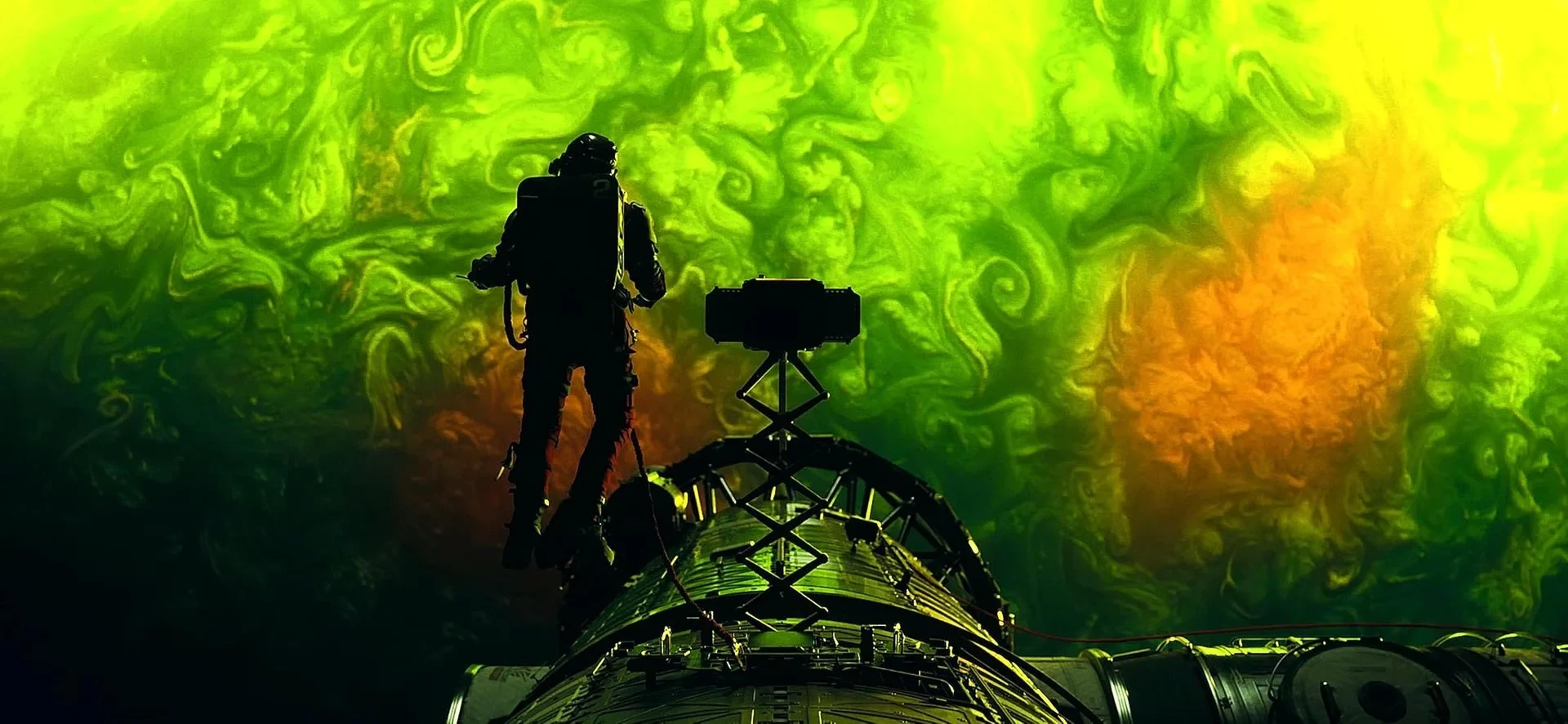
“Project Hail Mary,”a science-fiction novel that’s just been turned into abig-budget, big-screen movie, tells the story of an unlikely astronaut who unexpectedly encounters an alien during a desperate mission to save their respective civilizations. The astronaut (played by Ryan Gosling in the movie) and the alien have to figure out on the spot whether they’re friends or foes.
They also have to come up with a translation system that can accommodate two completely different ways of communicating. That all makes for a do-or-die space drama reminiscent of“Apollo 13”— but the day is fast approaching when advances in astronomy and artificial intelligence could take a lot of the drama out of alien contact. Seth Shostak, senior astronomer for the SETI Institute, says he wouldn’t be at all surprised if our first encounter with aliens came in the form of AI-to-AI contact. “My guess is that the aliens are going to be machines, because that’s what we’re doing, right?” he says in the latest episode of theFiction Science podcast.
“We’re just in the early days of building machines that can do things that humans have had to do in the past.
I’m sure that 100 years from now, the most capable intelligence on this planet will not be some sort of soft and squishy biological thing.
That’s going to be a machine.
And so, if we hear the aliens, I suspect that it’s more than likely that they, too, will be machines.” Click to launch the Fiction Science podcast on Spotify If you’re worried that talking about AI and the search for aliens will require delving deeply into spoilers, never fear: Artificial intelligence doesn’t really play a role in the “Project Hail Mary” movie.
It’s mentioned only once in theAndy Weir novel on which the movie is based— merely to explain why the planners of the do-or-die mission optednotto use AI.
(We do get into spoilers toward the end of this post, however, so consider yourselves warned.) Formore than 65years, astronomers have been searching the skies for radio signals that might have been sent out by extraterrestrial civilizations.
“The usual approach is to build a receiver that can monitor thousands — well, today, millions of different channels simultaneously,” Shostak says.
“And you can just look at how that capability has improved over time.
It turns out it follows what’s called Moore’s Law … which says that the speed of electronics more or less doubles every two years.” It takes a lot of computing power to monitor millions of channels, and Shostak says he’s certain that AI will accelerate the search for extraterrestrial intelligence, better known as SETI. There’s already evidence of that: Last November, the Breakthrough Listen Initiative reported that an AI system developed in partnership with NVIDIA could process real-time data from telescopes searching for fast radio bursts at a ratemore than 600 times faster than the current data pipeline.
The system improved detection accuracy by 7% and reduced false positives by nearly an order of magnitude. “This technology doesn’t just make us faster at finding known types of signals — it enables us to discover completely unexpected signal morphologies,” Andrew Siemion, principal investigator for the Breakthrough Listen Initiative,said in a news release.
“An advanced civilization might use burst-like communications, modulated signals or transmission schemes we haven’t even imagined.
This AI system can learn to recognize patterns that a human might miss entirely.” Several years ago, another team of astronomers used a machine language algorithm toidentify potential alien signals that were overlooked by other data-processing systems.
(But don’t get too excited: Follow-up observations didn’t confirm that the signals came from extraterrestrial civilizations.
You would have heard if they did.) AI tools could help astronomers overcome some of the obstacles facing the SETI quest.
For example, one group of researchers recently reported that signals from alien civilizations could bescrambled by stormy space weather.
Improved pattern-recognition software just might be able to pick out the signal hidden in the cosmic noise. AI models could also come into play for interpreting alien messages once they’re found.