EDITOR'S PICK
On Earth, aurorae are fleeting displays.
They occur when charged particles from the Sun strike Earth's magnetosphere.
Most of these particles are deflected away, but some particles become trapped and are directed toward the poles by magnetic field lines.
They find their way into the upper atmosphere where they collide with atoms and molecules.
This creates the energetic display in the sky, and the stronger the flow of charged particles from the Sun, the further the aurorae extend into middle latitudes. But on enormous Jupiter, aurorae are different.
The gas giant has the strongest magnetic field of all the planets.
If Earth's northern lights are a capricious, dance-like phenomenon, then Jupiter's are more like a permanent and violent electrical storm.
Jupiter's aurorae are also different from Earth's because they're shaped by interactions with its Galilean moons, a critical difference between the two. Rather than being driven by the Sun, Jupiter's aurorae are largely driven by its volcanic moon Io.
Jupiter's northern lights also have features that Earth's lack.
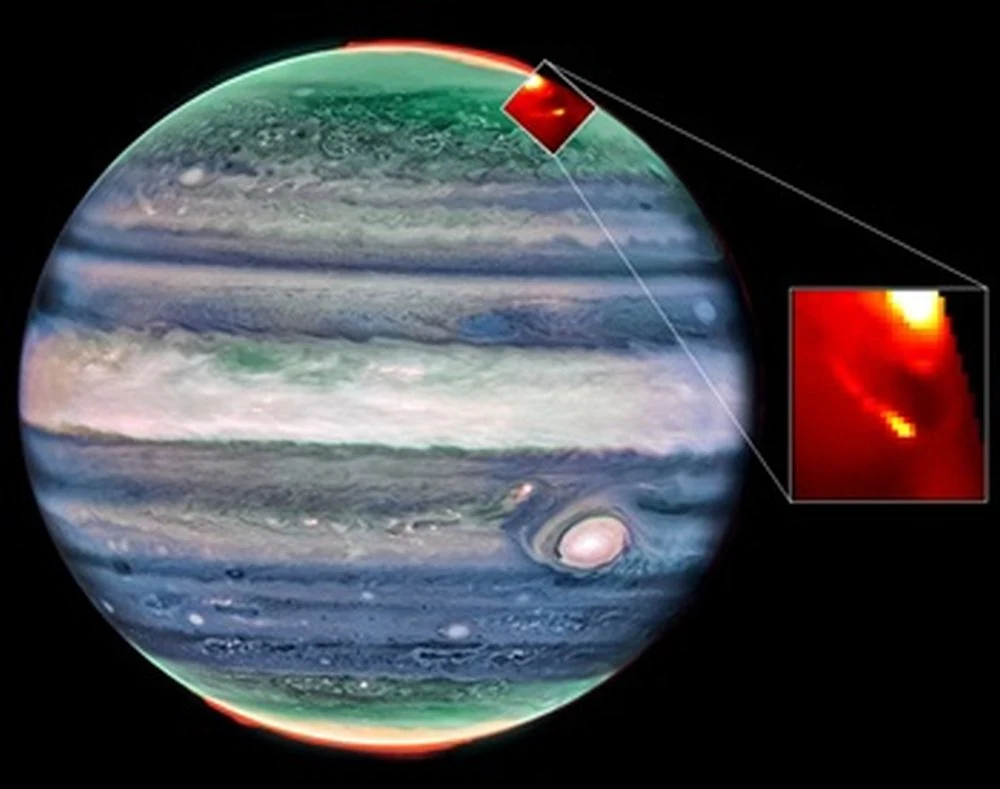
The magnetic field lines connecting the planet to its moons create bright spots on the aurora where the lines connect. New research in Geophysical Research Letters presents the first spectral measurements of these infrared auroral bright spots.
It's titled "Short-Term Variability of Jupiter's Satellite Footprints as Spotted by JWST," and the lead author is Katie Knowles.
Knowles is a post-grad researcher in the School of Engineering, Physics & Mathematics, at Northumbria University in the UK. If you want to know more about aurorae in general, it makes sense to observe Jupiter. "Jupiter's aurorae are the most powerful and continuously observable of any aurorae in the Solar System, and are a manifestation of the coupling between the atmosphere and surrounding space environment," the authors write.
The planet's powerful magnetic field, rapid rotation, and dense plasma environment make it the perfect place to understand aurorae better.
The dense plasma environment is largely because of atmospheric escape from volcanic Io, which forms a permanent torus of plasma inside Jupiter's magnetosphere.
It ejects about 1,000 kg into space every second, creating a ring around Jupiter known as the Io plasma torus. "A striking feature of the Jovian aurorae are the emissions associated with the Galilean satellites," the researchers explain.
Both Jupiter and its magnetic field rotate faster than the Galilean moons orbit.
That means that the four moons are continuously interacting with the plasma in the magnetic field.
That generates the bright spots. The bright spots on Jupiter's aurora are called Alfvén wing (MAW) spots.