LATEST
Finding Earth-like exoplanets with the composition and ingredients for life as we know it is the Holy Grail of exoplanet hunting.
Since the first exoplanets wereidentified in the 1990s, scientists have pushed the boundaries of finding exoplanets through new and exciting methods.
One of these methods is the direct imaging method, which involves carefully blocking out the host star within the observing telescope, thus revealing the orbiting exoplanets that were initially hiding within the star’s immense glare. Onlyapproximately 1.5 percent of confirmed exoplanetshave been discovered using this method, with one reason being atmospheric turbulence making ground-based telescopic observations difficult.
However, a team of researchers have proposed enhancing this method with the goal of finding an Earth-like exoplanet while mitigating these turbulence effects. Here, Universe Today discusses these findings that werepublished in a recent studyin Nature Astronomy that explores using a combination of ground-based telescopes with a space-based “starshade”.
We also share insight from the study’s lead author,Dr.
Ahmed Mohamed Soliman, who is a Scientist and Technologist at the NASA Jet Propulsion Laboratory, regarding the motivation behind the study, how their method compares to current direct imaging methods and upcoming missions, and next steps in making this concept a reality.
So, what was the motivation behind this study? “Many people think only large space telescopes like Nancy Grace Roman Space Telescope, James Webb Space Telescope, or the proposed Habitable Worlds Observatory can search for life beyond our solar system, but they aren’t aware of what our NASA NIAC funded study – Hybrid Observatory for Earth-like Exoplanets (HOEE) can do,” Dr.
Soliman tells Universe Today. For the study, Dr.
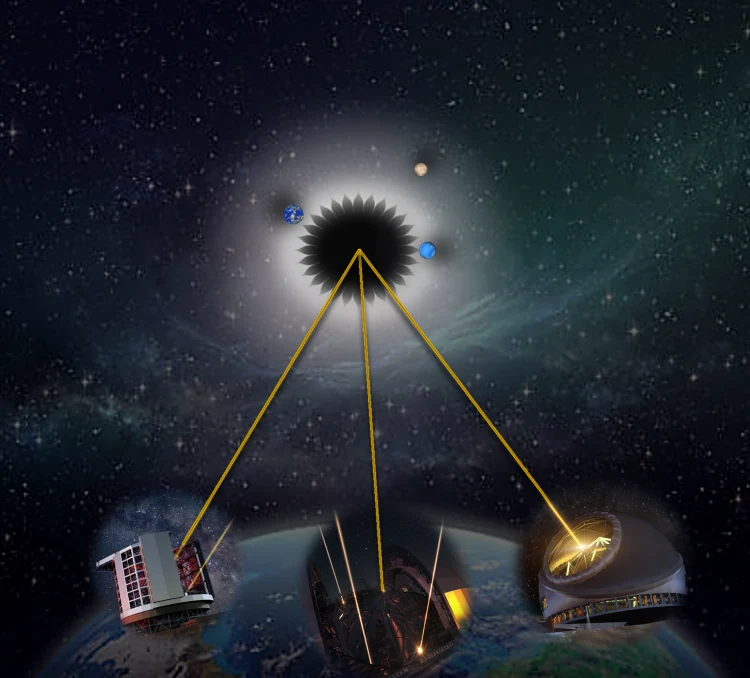
Soliman and his colleagues propose using a hybrid ground-space observatory concept involving an orbiting starshade measuring 99 meters (325 feet) in diameter and several powerful ground-based telescopes.
These telescopes include the Extremely Large Telescope (ELT), the Giant Magellan Telescope (GMT), and the Thirty Meter Telescope (TMT), with the ELT and GMT located in Atacama Desert (Chile) while the TMT is located in Hawaii (USA).
With the starshade blocking the star’s glare, revealing the previously hidden exoplanets, the ground-based telescopes will work to identify whether the exoplanets are Earth-like. Dr.
Soliman tells Universe Today the goal will be to identify dozens of Earth-sized exoplanets.
He also notes this concept will need only minutes to identify entire solar systems, including Earth-like exoplanets orbiting Sun-like stars, along with taking only hours to identify potential biosignatures. “Further, as shown in our Nature Astronomy studies, advanced adaptive optics on the ELT can correct atmospheric turbulence, allowing clear habitable exoplanet imaging and potential life detection under moderate weather conditions,” Dr.
Soliman tells Universe Today.
“The planet should lie within the star’s habitable zone, where conditions allow oxygen and water to exist.
For a Sun-like star, this corresponds to about 1 astronomical unit (AU), the Earth–Sun distance.
For nearby stars, this corresponds to an angle of about 0.1 arcseconds.
HOEE can observe at an angle as small as 0.058 mas [milliarcseconds] from the star.” As noted, thedirect imaging methodinvolves using specialized instruments within telescopes to block the star’s glare, revealing the exoplanets that were previously hidden.