TRENDING
It's a well-known fact that if humanity wishes to explore deep space and to live and work on other planets, we need to bring Earth's environment with us.
This includes life support systems that leverage biological processes - aka.Bioregenerative Life Support Systems(BLSS) - but also the many species of microbes that are essential to living systems.
Humans already bring microbes with them when they travel to space, in particular, to the International Space Station (ISS).
These microbes become part of the natural environment, sticking to surfaces, growing in nooks and crannies, and getting into everything. Given their constant presence, it's paramount that we understand how they survive in space.
In addition, they have potential uses that could enable greater self-sufficiency in space.
For example, certain types of bacteria and fungi extract minerals from rocks as a source of nutrients.
In a recent study aboard the ISS, researchers from Cornell and the University of Edinburgh investigated how these species could be used to extract platinum from a meteorite under microgravity conditions.
Their results suggest that this could be an effective method for obtaining mineral resources in space and lessening dependence on Earth. The study was led by Rosa Santomartino, an assistant professor of biological and environmental engineering in Cornell'sCollege of Agriculture and Life Sciences(CALS), and Alessandro Stirpe, a research associate in microbiology at Cornell and the School of Biological Sciences at the University of Edinburgh.
They were joined by researchers from theMedical University of Grazin Austria, Rice University, Cancer Research UK, theUK Centre for Astrobiologyat the University of Edinburgh,Kayser Space Ltd, andKayser Italia.
Their study was published on Jan.
30th innpj Microgravity. A bioreactor, produced by the BioAsteroid project at the University of Edinburgh.
Credit: University of Edinburgh The work was part of theBioAsteroid project, a collaborative effort between the University of Edinburgh and the European Space Agency (ESA).
This project is led by Charles Cockell, a professor of astrobiology at the University of Edinburgh and a senior author on the study.
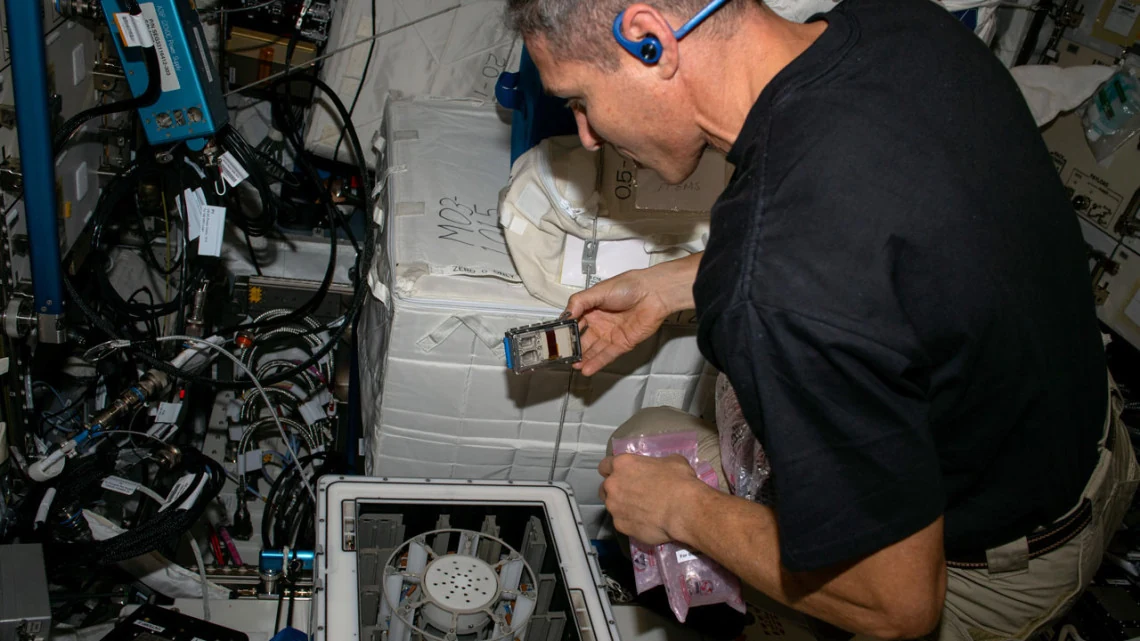
Cockell and his colleagues developed "biomining reactors" that were deployed to the ISS in late 2020/early 2021 to investigate how gravity affects the interaction between microbes and rock in microgravity. These reactors contained samples of an L-chondrite asteroid that were treated with the bacterium Sphingomonas desiccabilis and the fungus Penicillium simplicissimum.
These microbes are promising for resource extraction because they produce carboxylic acids that bind to minerals and release them from rocks.
However, there is still some ambiguity as to how this mechanism works.
To this end, the experiment also included a metabolomic analysis, in which a portion of the liquid culture was extracted and analyzed for biomolecules and secondary metabolites.
As Santomartino said in aCornell Chronicle press release: This is probably the first experiment of its kind on the International Space Station on [a] meteorite.