TRENDING
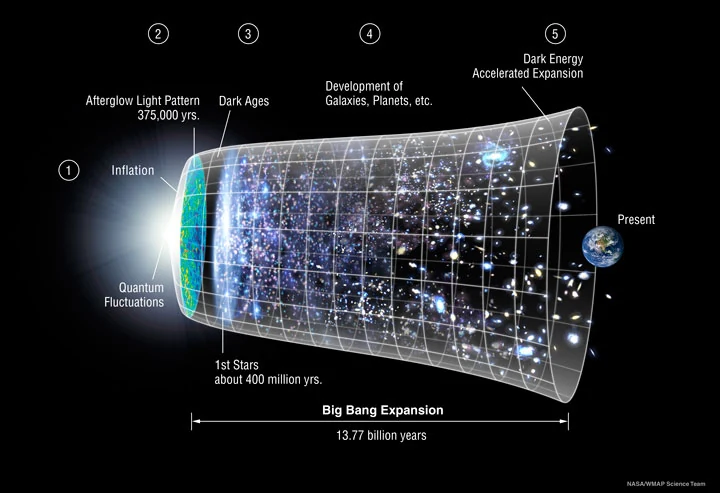
For about a century, scientists have known that the Universe is in a state of constant expansion.
In honor of the scientists who definitively showed this, this expansion has come to be known as the Hubble Constant (or Hubble-Lemaitre Constant).
Today, scientists use two main techniques to measure the rate of expansion: the Cosmic Microwave Background (CMB) and the Cosmic Distance Ladder.
The former relies on redshift measurements of the CMB, the relic radiation left over from the Big Bang, while the latter relies on parallax and redshift measurements using variable stars and supernovae (aka "standard candles"). The only problem is that the two methods don't agree, leading to what is known as the "Hubble Tension." This problem is considered one of the greatest cosmological mysteries facing scientists today.
Luckily, new methods are emerging that could help resolve this "tension" and bring order to the Standard Model of Cosmology.
In arecent study, a team of astrophysicists, cosmologists, and physicists from the University of Illinois and the University of Chicago has proposed a new method using the tiny ripples in spacetime known as gravitational waves (GWs). The study was led by Bryce Cousins, an NSF Graduate Research Fellow from theInstitute of Gravitation and the Cosmos(IGC) at the University of Illinois Urbana-Champaign.
He was joined by multiple colleagues from the IGC, as well as researchers from theKavli Institute for Cosmological Physicsand theEnrico Fermi Instituteat the University of Chicago.
Their study, "Stochastic Siren: Astrophysical gravitational-wave background measurements of the Hubble constant," appeared on Jan.
16th in the Physical Review Letters. Scientists hoping to resolve the Hubble Tension have proposed several solutions, ranging from Early Dark Energy (EDE) and interactions between Dark Matter (DM) and neutrinos to evolving dark-energy dynamics.
In recent years, the discovery of gravitational waves has also emerged as a means of resolving the Tension by providing a new way to measure cosmic expansion.
Originally predicted by Einstein's Theory of General Relativity, gravitational waves are ripples caused in the fabric of spacetime caused by the merger of massive objects (neutron stars and/or black holes). They were firstconfirmed in 2016by scientists at theLaser Interferometer Gravitational wave Observatory(LIGO).
Thanks to upgraded instruments and international cooperation, the LIGO-Virgo-KAGRA (LVK) collaboration has detected more than 300 GW events.
In that time, astronomers have found ways to use events to explore cosmological phenomena, including measuring the expansion of the cosmos.
In the current research, the team found a way to improve these measurements by leveraging the gravitational-wave background (GWB), which is caused by astrophysical collisions that the LVK network is not yet sensitive enough to detect. They call it the "stochastic standard siren" method, since the collisions that make up the gravitational-wave background occur stochastically.
Daniel Holz, a UChicago Professor and study co-author, explained in a UIUC press release: It’s not every day that you come up with an entirely new tool for cosmology.
We show that by using the background gravitational-wave hum from merging black holes in distant galaxies, we can learn about the age and composition of the universe.
This is an exciting and completely new direction, and we look forward to applying our methods to future datasets to help constrain the Hubble constant, as well as other key cosmological quantities. Artist’s impression of the electromagnetic signal from the merger of two neutron stars.
Credit: NSF/LIGO/Sonoma State University/A.