TRENDING
When most people think of a supernova, they're thinking of a Type II core-collapse supernova.
These are massive stars that have reached the end of their time on the main sequence.
They've used up their supply of hydrogen and continue fusing heavier elements until the star can't support its own mass.
The core collapses and they explode, outshining their entire host galaxy for months. When something this bright happens in the sky, it immediately captures astronomers' attention.
Ancient Chinese astronomers called supernovae explosions "guest stars" because they appeared, hung around for a while, then disappeared.
They documented thesupernova from 1054extensively, making it one of the ancient world's most well-documented astronomical events.
That Type II supernova created the well-known Crab Nebula, one of the most thoroughly-studied objects in astronomy. Researchers have pieced together much of the complex detail behind Type II supernovae.
But astrophysicists still have questions.
One of them concerns their extended envelopes and their light curves. New research in a pair of papers has made some headway in answering these questions.
The first paper is "Critical Metallicity of Cool Supergiant Formation.
II.
Physical Origin," published in The Astrophysical Journal.
The lead author is Po-Sheng Ou, from the Institute of Academia Sinica, Astronomy and Astrophysics, Taipei. The second is titled "Multi-wavelength Signatures of Supernova Shock Breakout from Red Supergiants in Two Dimensions," and is also published in The Astrophysical Journal.
The lead author is Wun-Yi Chen, also from the Academia Sinica, Institute of Astronomy and Astrophysics, Taipei. Only massive stars can explode as supernovae, and most precursors are red supergiants (RSGs), with blue supergiants being responsible for a small number of them.
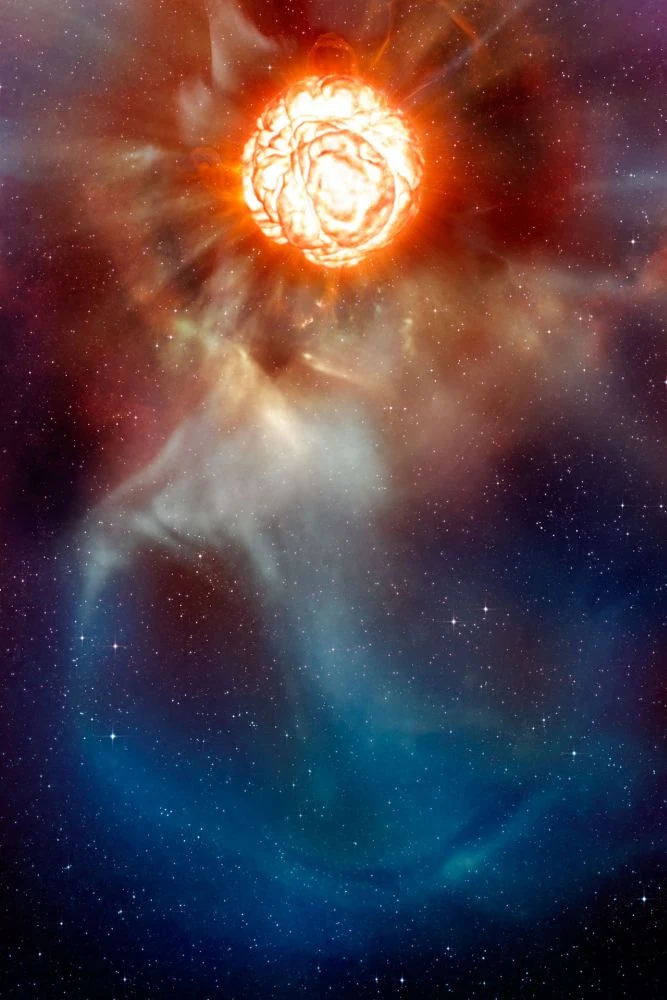
The star Betelgeuse in the constellation Orion has been a RSG for about 40,000 years, and will explode sometime in the future, most likely within 100,000 years.
It already shows signs of ejecting material into an envelope around itself. The actual physical origins of extended shells like this in SN progenitors is still somewhat mysterious, but the first paper makes some progress. In the first paper, the authors explored the metallicity of supergiant stars with models of stellar evolution.
"This study investigates the physical origin of the critical metallicity required for the formation of cool supergiants, as revealed by stellar evolution models," they write.
They found that there's a threshold where the precursor star's radius determines whether a star of a given mass can become a red supergiant. Metallicity affects a star's nuclear burning and opacity, and in turn affects the star's radius once it leaves the main sequence.