EDITOR'S PICK
Most objects that astronomers and astrophysicists study have existed for billions of years.
Things like supermassive black holes, the Milky Way galaxy, even the Sun and the Earth predate humanity by billions of years. But not the Crab Nebula.
It's the supernova remnant (SNR) of a supernova that exploded about 6,500 years ago.
It's light reached Earth in 1054, and the exploding star is called SN 1054.
Ancient astronomers recorded its appearance in the night sky, especially Chinese astronomers who called it a "guest star." The Crab Nebula is one of the most well-studied objects in astronomy.
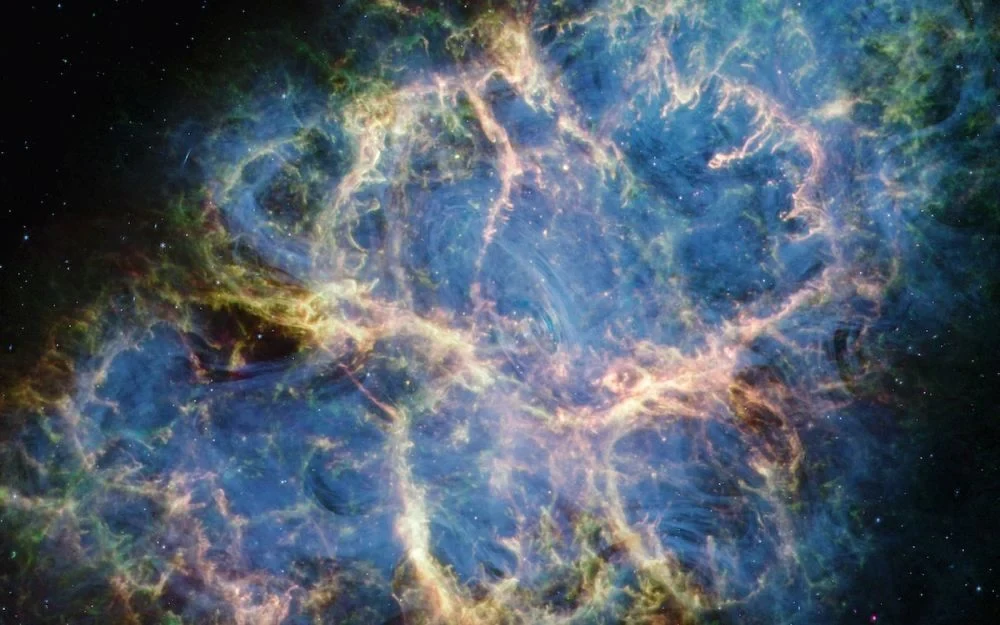
Its striking appearance makes it recognizable to more than just astronomers, and it's been imaged many times in great detail by different telesocopes, including the Hubble.
Its Crab Nebula image is like the space telescope's calling card. There's a lot going on in a complex object like the Crab Nebula, also known as M1 and NGC 1952.
It's not only classified as a SNR, it's also apulsar wind nebula.
A central pulsar generates the winds that drive an expanding bubble of high-energy particles outward.
It also drives the outward expansion of magnetic fields. This image is a combination of optical light from the Hubble (red) and x-ray light from the Chandra Observatory (blue).
The red star in the center is the Crab pulsar, and the central part of the image shows the pulsar wind nebula.
Image Credits: Optical: NASA/HST/ASU/J.
Hester et al.
X-Ray: NASA/CXC/ASU/J.
Hester et al.
- https://hubblesite.org/contents/media/images/2002/24/1248-Image.html, Public Domain, https://commons.wikimedia.org/w/index.php?curid=238064 A typical pulsar emits one radio pulse per rotation.
A few have two.
In most pulsars, the two appear in different parts of the rotation. But the Crab Nebula stands out from other pulsars.