LATEST
It's strange that a dying star is at the heart of this glowing cloud of gas, ionizing it and lighting it up almost like a living structure, but that's Nature for you.
An agingWolf-Rayetstar, which has exhausted its hydrogen core, illuminates the Cat's Eye Nebula from within.
The star, catalogued as HD 164963, has suffered episodic mass loss as it ages.
Each complex layer in the gaseous nebula represents one episode of mass loss driven by the star's extremely powerful winds. The star's death convulsions created the shells of gas shed by the star thousands of years ago, and it's radiation turns them into natural artwork. TheCat's Eye Nebula, also known as NGC 6543, is about 4,300 light-years away in the constellation Draco, according to the ESA's Gaia mission.
When first observed in 1786, it looked like a planet in the telescopes of that age, and was called a planetary nebula.
Almost a century later, it was the first nebula to have its spectrum studied, showing that it was stellar, not planetary, in nature.
Now, of course, we know that planetary nebulae like NGC 6543 have nothing to do with planets at all. The nebula is one of the most popular objects in astronomy.
It's also a popular target in astrophotography, though it's more challenging to image than some other targets. Many telescopes have captured its portrait.
The Chandra Observatory and XMM-Newton space telescopes have both observed it in x-rays.
The Herschel Telescope and the Subaru Telescope have both studied it from the ground.
The gold standard for Cat's Eye Nebula images is a combined image from the Hubble and Chandra.
That image makes NGC 6543 look organic in nature. This image of the Cat's Eye Nebula is a composite image made from Hubble data and Chandra data.
In this image, red is hydrogen alpha, blue is neutral oxygen, and green is ionized nitrogen.
Image Credit: By J.P.
Harrington and K.J.
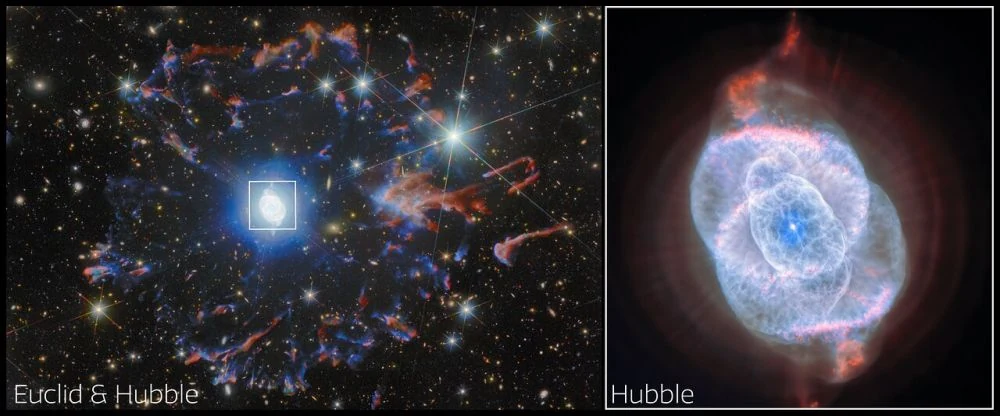
Borkowski (University of Maryland), and NASA - HST's Greatest Hits, Public Domain, https://commons.wikimedia.org/w/index.php?curid=36064 This new combined image from the ESA's Euclid Space Telescope and the Hubble doesn't show the internal detail as well as other images, but it places the stunning nebula in context.
Euclid is a wide-field telescope whose main job is to study dark energy and dark matter.
It shows how the Cat's Eye Nebula is sitting in a field full of distant galaxies. Euclid's wide field of view places the Cat's Eye Nebula in context.